
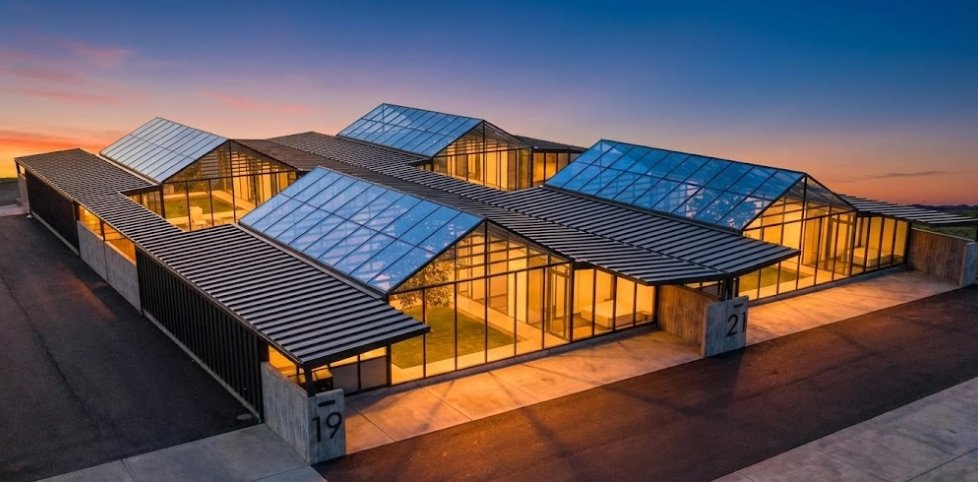
A four-bedroom home for £167,000, designed to have no energy bills.
Atreeum builds villages of around twenty family homes on rural exception sites, the planning route that lets a parish build for its own people at prices set by local wages rather than the open market. This page is the whole proposition on one screen, with the numbers behind it.
A house that earns its keep.
Atreeum is a new model for housing development that uses twenty-first-century infrastructure to cut the cost of living. Instead of treating a house as passive shelter, it turns a cluster of homes into a productive green-energy and edge-computing hub. Off-site manufacturing and clean data infrastructure together generate enough commercial income to remove household energy bills, fund shared community assets such as the electric-vehicle fleet, and keep around a million pounds of shared infrastructure out of the price of the homes.
The core architecture: volumetric pods and atriums
Every Atreeum home relies on precision manufacturing. Each house is built from two high-performance, highly insulated volumetric pods, built in a factory to Passivhaus principles, transported to site and joined by a light-filled glazed atrium. The design achieves structural quality, superb energy performance and real architectural character, without the monotony of conventional modular housing.
Infrastructure and the financial engine
The financial sustainability of an Atreeum village comes from its own decentralised infrastructure. Each village runs as a micro-grid and local data hub, backed by a capital contribution of around £1 million per village from Atreeum Infrastructure. That investment funds a substantial solar array, battery storage and a whisper-quiet edge compute core embedded in the community.
AI and digital platforms face a global shortage of power, so technology companies pay a premium to route workloads to green edge servers with a guaranteed supply. Each home generates an average of 38,000 kWh of solar energy a year, far more than a household needs. The surplus powers the compute core, and the compute core's waste heat provides heating and hot water for the homes. It is a closed loop.
Community and landowner partnership
Each village operates within a Community Benefit Society. A proportion of the revenue from the energy and digital infrastructure is asset-locked within the society, so profits cannot be stripped out by outside corporate interests and the benefit stays focused on driving down costs for residents.
Land is unlocked through Rural Exception Sites, working directly with local landowners and parish councils. Landowners receive long-term value, parishes secure permanently affordable homes for local people, and the village avoids speculative development on its edge. The result is a self-sustaining ecosystem built to deliver abundance.
Under five times a local wage, in parishes where the median home is ten or more.
In the rural parishes we have studied in depth the median home sells for ten to thirteen times the local full-time wage. At £167,000 an Atreeum home is under five times that same wage, and about 4.3 times the UK median, which puts it back within reach of one ordinary income, or a couple with a modest deposit.
It is not shared ownership and not a discount scheme with strings. You own the home outright. The one condition is the one that makes the price possible: the homes go to people with a genuine connection to the parish, and they cannot be sold on for open-market value.
The price comes from three decisions that were designed together, not from one trick:
- The land. A rural exception site is for local-needs housing only, so it costs a fraction of land with open-market permission.
- The build. Around twenty identical homes, factory-built as two pods and a glazed atrium, on screw piles instead of a concrete slab, with the design paid for once across every village.
- The infrastructure. The solar, batteries, heat network and fleet are owned by a separate operating company and paid for from the village's own income over 25 years, so they are not in the house price.
The village makes about nineteen times the electricity its homes use.
Each village carries 800 kWp of solar, around 760,000 kWh a year, with battery storage, a district heat network and a shared fleet of V2G-capable electric cars whose batteries double as the village's store. The homes together use around 40,000 kWh a year. The system is designed to eliminate household energy bills for heating, hot water and electricity.
The heat comes from an unusual place. A small compute core at the centre of the village processes data for outside customers, and its waste heat is captured and piped to the homes and the growing house. A kettle that thinks, and a village warmed by it.
Net-zero homes, and a village that gives more energy back than it takes.
- Factory-built pods arrive finished and are lifted onto the piles, which means less waste, fewer site deliveries and a twelve-week build.
- Waste heat is reused rather than vented. The compute core's heat warms the homes and a commercial growing house, so the same energy does two jobs.
- Surplus is exported to the grid and used for grid services, so the village supports the local network rather than loading it.
- Two acres for around twenty family homes and their shared green space, on the edge of an existing village rather than in open countryside.
A car when you need one, a beautiful, light, spacious garden room, and neighbours you already know.
The shared fleet
Around twenty V2G-capable electric cars, one per home, booked when you need them and charged from the village's own solar. Per-mile rates are set well below the cost of owning and running a car, and when the cars are parked their batteries are working for the village to balance generation with consumption.
The atrium
The two pods of each home are joined by a glazed atrium: 800 square feet of weather-tight garden room. This is the space a conventional house never has room for.
The Seed Fund
Every village carries a £25,000 Seed Fund. The first person to register in a parish, the Radicle, receives £6,000 off their home, and £1,000 more for each of the next nineteen registrations, to keep or pass on to the neighbours who join them.
The cost build-up, so you do not have to take the price on trust.
A comparable four-bedroom rural new-build costs £200,000 to £260,000 to construct before land, finance and profit. Atreeum's total cost is £130,505 per home. The two tables below show where the money goes and, separately, what the village operator funds so that it never contributes to the house price. All figures exclude VAT.
| LandTwo acres of rural exception site at £100,000 an acre, shared by around twenty homes | £10,000 |
| FoundationsThirty screw piles, GPS-installed. No slab under the atrium. | £4,800 |
| Factory-built structuresLiving pod, sleeping pod, atrium, glazing, walkways, garden and parking canopies | £56,540 |
| Kitchen, bathrooms and utilityFitted in the factory | £11,490 |
| Services and finishesVentilation with heat delivery, electrics, plumbing, lighting, hot water cylinder, flooring | £21,460 |
| Design, surveys, legals, compliance, insurance and site preliminariesDesign is paid once across all villages. Includes the Seed Fund provision. | £6,215 |
| ContingencyHeld per home. Released if unused. | £20,000 |
| Total cost per home | £130,505 |
| Finance, sales, warranty, overheads and developer margin | £36,495 |
| Sale price | £167,000 |
| Village civilsRoads, pavements, foul drainage, storm attenuation, pipework | £250,000 |
| MicrogridPrivate wire, switchgear, metering, grid connection | £175,000 |
| Solar, inverters and chargepoints on the homesFitted to each home, owned by the operator | £171,800 |
| Growing houseCommercial glasshouse, heated by the village | £95,000 |
| V2G fleet hardwareBidirectional chargers for around twenty cars | £80,000 |
| Battery storage | £65,000 |
| Heat networkDistrict pipework to every home | £61,000 |
| Heat store and backup heat pump | £110,000 |
| Compute core | £35,000 |
| Kiln and workshop | £19,000 |
| Total per village | £1,061,800 |
| Equivalent per home, carried by the operator | £53,090 |
Rural exception site
Land that would never get open-market permission can be built on for local-needs housing only. That takes open-market land value out of the price entirely. NPPF paragraphs 76, 82 and 83 and Annex 2.
Design paid once
One home, designed in full, built around twenty at a time in a factory. The tenth village costs less per home than the first, and the hundredth less than the tenth.
Infrastructure funded separately
The operator earns from the compute core, the growing house and kiln leases, the car fleet, energy export and grid services, which is what pays for the shared systems and keeps the bills at zero.
The full line-by-line evidence base, the live village energy model and the planning-pathway work are open to journalists, employers, councils and partners on request. Every line, with a walkthrough.
Twenty local people is the number.
- RegisterFree, ninety seconds, no commitment. Your parish appears on the live map.
- Reach twentyWhen twenty people with a local connection register in one parish, the village becomes buildable and the Seed Fund is full.
- PlanningAtreeum opens the conversation with the parish council, the landowner and the planning authority under the rural exception route.
- BuildTwelve weeks on site. Eighteen to thirty-six months from the first registration to keys.
A local connection usually means living in the parish or nearby, working there, or having close family there. The exact test is set by each council, and a job in the parish normally counts.
Put your parish on the map.
More than five hundred people across some five hundred parishes have already registered. No village is built until twenty of them are in the same one.